Wednesday, September 10, 2008

Foiling tips, Wingtips

Wow! What a neat couple of posts. The UK interview with AMAC, John, Scott and Si got me thinking about so many things moth related that I need to work on, I printed it out and taped it to my bathroom mirror. Control systems - yes, rig tension - yes, fitness for sailing -yes. Stop typing, Joe and get busy. But, it's the middle of the day and I'm still at work.... At any rate, thanks Thierry and IMCA-GBR.


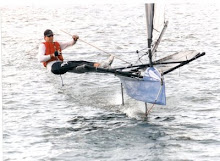
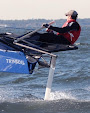
Mike at Aardvark Racing has also recently posted a pic of his Axiom's rudder foil with upswept tips. So I started thinking about wing tips. Anyone who's flown commercial has seen winglets on jets, from small corporate-types to wide-bodied long distance haulers. The theory is straightforward - reduce the tip vortex and get an effectively longer span resulting in more lift with less drag. So why don't we see them on aircraft tail horizontal fins? Probably because on a plane, the wing generates almost all of the lift and the horizontal component of the tail is lightly loaded and acts primarily as a stabilizer, as opposed to the configuration of most moths where the rudder foils generate a substantial portion of the total lift (30%???). So wingtips on moth foils should be of some benefit. But on the rudder? With the rudder's foil swinging with every twitch of the tiller, I wonder if the wingtips on the Axiom are helping or hurting? Rudders can be shaped to reduce the stall angle by tweaking the shape of the leading edge, but I would think the leading edge of a winglet would be so thin that a stall of the winglet would easily occur at relatively small angles of attack.

The centerboard's main lifting foil, on the other hand, while still changing its angle in the slipstream as the boat's heading is changed, undergoes a much smaller differential in angular amount per unit time than the rudder's foil. So perhaps wingtips on the main foil make more sense. I'm not an naval architech or designer, although I wish I was sometimes, so these thoughts are just my ruminations about what's happening "down there." And no, I haven't be talking with Doug Lord....

Here's another thought: why not a rudder set-up similar to an aircraft's rudder with non-pivoting vertical and horizontal sections and the actual rudder as a hinged flap off the back of the fixed fin. Racing shells often have the rudder as an articulated section off the back of the fin (and yes I know that rowing shells don't have to turn 90 degrees in a couple of seconds...) But with such a set-up the rudder's lifting foil could benefit from wing tips just like the main foil. Of course, there is still the method of rudder articulation (perhaps a pivoting rod inside the fixed vertical section?) The mechanics are for the engineers, but I would reckon with an articulated vertical flap (maybe 50-60% of the chord), an articulated horizontal flap would be out of the question and the whole rudder gantry would need to be canted to affect AOA of the rudder's lifting foil. Heck, I'm just tossing out what-ifs...

So much for thinking out loud, my next class is about to start and I need to get back to the maths. Maybe sailing tonight after work is in the cards.

Monday, September 8, 2008

The Little Tramp Discussion


So, who did the character better, Chaplin or Downey? No, no, not that Little Tramp! The discussion is about tramp materials, and it's just a little discussion...

Why not black poly mesh instead of Dacron? Most folks realize that Dacron tramps degrade quickly, especially if they're used frequently. Black polypropylene mesh tramps, as used extensively on A-Cats, are almost indestructable. Also, white dacron is slippery, contributing to the cheese slicer effect after a stack. The poly mesh has a little more grip so it's harder to slide out (or forward!) Lastly, the mesh will drain water a bit faster after a capsize, resulting in less water being scooped into the floor area. One drawback noted by someone, is that black is a bit less visible when capsized, but I would argue that if white caps are prevelant, white tramps wouldn't necessarily be that great either.

Three of us on the US east coast with home builds have black poly tramps, Bill and Gui switching over after getting tired of replacing their torn Dacron. My boat was originally launched with black mesh. Is there anyone else on the Dark Side?

Sunday, September 7, 2008

Low Riding Blues

The forecast 15-20 failed to materialize - perhaps the fast moving low just took away any pressure gradient that was expected. I did, however, get three hours on the water today - 45 minutes blasting across the harbor in a nice 10-12 knot breeze that then dwindled down to 6-ish. I had sailed over to the Hampton Yacht Club big boat regatta to see some friends and wow 'em with the boat. But once the breeze died and I fell off the foils I just couldn't get it back up (no little blue pill jokes, please.) So I spent most of the time low riding. Not much fun and with the tide coming into the harbor I decided to bail out early and head back to Willoughby lest I get swept up the James River. Crossing the main shipping channel is alway dicey with the amount of traffic that comes into Hampton Roads, but luckily just at the channel's edge a little puff come in and I scooted across on foils in front of (but well clear of) a lighter barge and tug.

The whole experience drove home the point about how important it is to foil soonest. Si certainly had the technique at Weymouth as he was sailing circles around everybody during a practice session a few days before the worlds started. My handicaps are three-fold: first I weigh about 170 pounds, certainly more than the flyweights. Secondly, my klutzy foils are pulling huge drag buckets. That problem hopefully will be solved (if I can find the $$$) with an AMAC blade and main foil to replace my centerboard. My third problem is a sail tear on the top batten pocket that is allowing the top of the sail to fall off to leeward. It's not a big problem in a breeze, but it surely contributes to muchoo less drive up top, which is what I need in the moderate stuff. So, sometime soon I need to take a trip to a sailmaker.

Anyway, after the couple of hours coming home in about 5 knots of breeze I felt pretty comfortable in low-rider mode. Of course I disconnected the cable from the bell crank to allow the flap to find its own minimum drag position. Not fun, but still time in the boat is contributing to my figuring out the beast.

Saturday, September 6, 2008

Vortices

Today was spent inside watching the leaves fly around the yard as Hanna skirted by. No great damage as the wind only got to about 50 mph tops. We rented Pirates - At World's End on DVD. Talk about way too much lift on the rudder!

Meanwhile, in the real Caribbean, category 4 hurricane Ike is roaring like a lion, heading toward the north shore of Cuba. In all likelihood Ike will miss the east coast of the US but will make his presence known in the Gulf next week.

Tomorrow, I'm going sailing. The breeze is forecast to be 15-20 and last time out I had a bit too much lift in the stern causing the rudder to spin out so tomorrow I'll try a scooch less angle on the rudder foil. Stay tuned.

Friday, September 5, 2008

Wait Room

I was going to try to get out on the boat today and tomorrow, but Norfolk will be indundated in the next 24 hours with the wind and rain of tropical storm Hanna. Gusts should be around 50 mph and perhaps 3-4 inches of rain. So, it looks like I need to wait until Sunday to get some more time in. Wait, wait, wait.

At the reception on Sunday Anna Tunnicliff was asked by one of the juniors to describe her typical day. She responded that during the season, her routine consists of 2 hours a day in the weight room, six days a week, and 3-4 hours on the water, at least four days a week. Sailing, of course, but also significant time in the gym. Weight training. Cardio. Strength and endurance. Boy, do I need all of the above. One of my perks as the rowing coach at the school I work is the availability of the Concept 2 erg. They are used by every organized rowing program in the country, from high schools through to the olympic team. Many commercial gyms have ergs as standard pieces of equipment. At Weymouth I saw that the GBR sailing team members were erging before their practice sessions. The erg is a good tool to increase both cardiovascular condition and muscular strength. I like the erg because it avoids the joint pounding that running causes.

So it's to the weight room for me. Set the damper to "3" and pull away. Last weekend when I was drifting around the race course in my wife's classic moth, I ended up sculling about a quarter of a mile back to shore when the race was abandoned. The sawing motion of the hiking stick reminded me of the in and out of the sheet in a breeze. My biceps were sore the next day, indicating a need for serious improvement to this 53 year old body. I wonder what keeps AMAC in shape?

Thursday, September 4, 2008

Mach Two

I excited about Si's and AMAC's collaboration on the new MACH 2 that will be available next year. I hope to buy a new centerboard and main foil from KA that utilizes the same horizontal piece (but a slightly different vertical piece) as the new boat to replace my existing board and main foil. I know that I wouldn't think of cutting my own sail and expect the result to be competitive, so why did I think my construction of the blades will produce competitive results? Even with Gui's guidance and Bill's main foil mold I managed to screw up the end product. Sure it works, but I'm positive the drag is substantially more than what is happening below a Prowler, a BR or even Bill's and Gui's homebuilds.

But back to the Mach 2: it's interesting to me that Andrew has gone back to McConaghy as the builder, even as Bladerider has bailed out from the relationship with the same builder. I'd love to be a fly on the wall listening to the negotiations that get the big fish to play with the little guys. While the complete boat should be a very nice package, it seems to me that the critical bits are the rig and the blades. I've got a reasonably light and stiff hull in my Hungry Beaver (19 pounds before the paint and fittings) even if it has a bit more volume and surface area than is fashionable.

So look out for me next year! I probably won't be able to take delivery before the season shuts down me in December. (No frostbiting for this wimp.) Right now for me it's save-the-nickels-and-dimes time.

Wednesday, September 3, 2008

Varsity League


So the guys on the right coast are trying to get an organized regatta experience instead of the pick-up sailing that we have been doing. Peter has an in at the American Yacht Club and their annual High Performance Dinghy Open in October. Classes participating include FDs, 5o5s, Fireballs, 470s, I-14s, 49ers, ICs, RSK6s (whatever that is) and A-Cats. If we get a minimum of six boats we'll consitute a class, if not we're relegated to a Portsmouth Yardstick Fleet with handicaps.

Right now it looks like we may be able to muster the six boat minimum, but if we don't it will be a neat experience with some high calibre talent. How high? Bill has sailed his canoe up there a half a dozen times and he writes "AYC strikes me as a varsity venue. It's beautiful, and a great place to sail when all goes well, but in the half dozen HPDO regattas I've made, probably half served up conditions I would not be comfortable moth sailing. When it blows it blows hard, the waves can be impressive and the friendliest shore line available is the concrete launch ramp we launch from. Everything else is rock."

Great. The downside for me is a ten hour drive with the possibility that it might be a pain to launch and sail (sounds like what happened at Weymouth?) The upside is that the regatta is sponsored by Heineken and there's a photo by Photoboat, a nice dinner and a t-shirt included in the $50 entry fee. Peter is talking about putting up the mothies. So, yeah, I'm game for the varsity level. Put me in, coach!

About the PY numbers: US Sailing has no data on foilers. So this would be an opportunity to at least get the class on the radar screen. What number might we sail at? Gui was passing A-Cats on the reaches in the moderate stuff, and he claims his reaching speed is a couple of clicks below Bill's speed. Bora would be over the horizon in the same conditions. I'm guessing a D-PN around 60? Here's the table from US Sailing.