Tuesday, January 12, 2010

Rudder foil planform area.

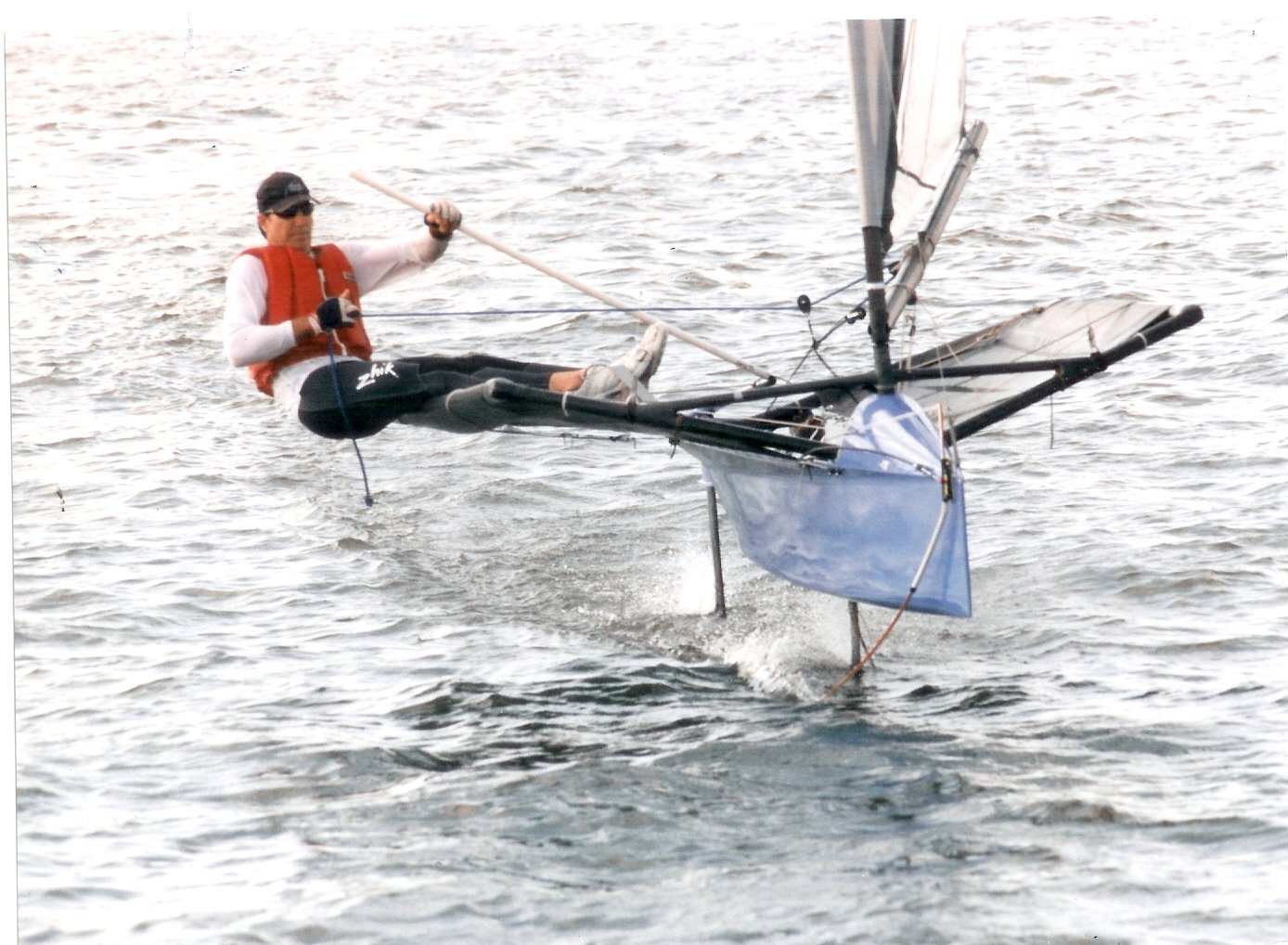
So Amac won the Australian Nationals (due in a large measure to his talent) but it seems part of his kit was a "smaller" than normal rudder horizontal. So just how large was it? How large is yours? (We're still talking area of the horizontal, here.) For a couple of data points here are the dimensions of my two rudder horizontals:

My first rudder horizontal, a Gui super-large (the one I used at Weymouth)


Span 40 inches, Max chord 4.75 inches, Chord two inches from tip 2.75 inches. Approximate area 142.5 sq inches (920 cm^2). This foil has a minimal bulb. It's mounted to its strut at a 90 degree angle. In practice it seems to balance best with a slight negative AoA, perhaps due to it high lift cross sectional shape.


My 2nd horizontal, a Bora built, Beiker designed (the one I used at the Gorge)

Span 30.75 inches, Max Chord 4 inches, Chord two inches from tip 2.375 inches. Approximate area 94.2 sq inches (608 cm^2). The foil has a rather large bulb and "tail." It is mounted to a forward canting strut, similar to the M2 rudder. It was with this rudder, before the gantry exploded (another story) that I clocked my 20.3 kt avg at the Gorge (in all likelihood a greater speed over the bottom since I was sailing downwind but up current.)


Lastly, here's a pic of the two back-to-back. I don't have a reliable micrometer, but the Beiker foil is much thinner than the other.

I suppose that smaller and thinner is better. Since I don't have the "stock" BR, M2, or Assassin dimensions, could someone please provide them? It would be interesting to see the range of what's actually being used out there. My suspicion is than thin foils with a shallow AoA are the way to go fast. As Simon says, "discuss..."

Monday, January 11, 2010

Surf video camera


While thumbing through a confiscated Surfer magazine (yes, kids still try to bring these things into the classroom) I noticed an ad for a new "surf cam" from GoPro.com Prices seem reasonable: standard definition wide angle lens for US$160 and a High Def version for US$300. The videos on the website show lots of options: helmet cams, bow and stern mounted cams (and I'm sure it would be easy to do the masthead mount.)

So what are folks using to produce foiling videos?

Sunday, January 10, 2010

Full Results here

In deference to mid-fleeters and home builders around the world, here's a link to the full results. Congrats to Andrew McDougall on winning (from someone else who just turned 55 years old) but also to Andrew S., Luka, Alan, Phil K., Brent, Richard, John, Chris, Benjamin, Phil S., James, Ian, Phil L., and Cain. Now that we've had our Phils, let's get back to the conversion of a 45 year old Shelley to accommodate foils. I'm still laminating bits of carbon and expect to tear off Aftermath's foredeck this week to install a control rod through-tube (nixing a Morse cable set-up as too old school.) The Classic Moth Midwinters start in 27 days. Stay tuned.

Saturday, January 9, 2010

AMAC takes three more bullets

The event website is hard to come by but I found some results that show McDougall taking three more bullets in the last three races of the Australian Nationals. Andrew Stevenson and Luke Damic are tied for 2nd, 13 points back. Luke's description of AMAC sailing off the wind also matched what we saw Bora accomplish at the Gorge Worlds with his "deeper and faster". So what is it that allows the M2s to dominate on the leeward legs? Can Andrew continue his streak in the lighter breezes predicted for tomorrow? Can we get some more play-by-play? The world is watching.

Wednesday, January 6, 2010

Bora named Rolex YotY

From Scuttlebutt:

Rolex Yachtsman of the Year - Bora Gulari (Detroit, Mich.)
Gulari earned the coveted award with his very first appearance on the shortlist of nominees. Gulari had tough competition for the honor: all but one of the 10 male nominees, Gulari included, had won a world championship title. Ultimately, 10 of the 14 panel members gave Gulari their first-place vote, acknowledging his growth from square one in the Moth class two years ago to winner of the CST Composites International Moth World Championship in 2009 as nothing short of remarkable.

"I just do this because I love it, and I think this year was the start of great things to come for dinghy sailing in the U.S.," said Gulari. "With the addition of the foils, the Moths became easier to sail and a lot more rewarding. . . generating a level of excitement for sailing in some of the top sailors in the country that I have not seen before. I don't think it will take people away from traditional dinghy classes, but the Moth is so fun that it's attracting people that have never had any interest in dinghies, and its bringing people back to dinghies who thought they were
done getting wet."

Anna Tunnicliffe was named this year's female winner. Mothies seem to have the little bit extra that gets 'em to the top. Anna has spent a good bit of time on moths with Brad Funk her husband. Jeff Linton, the RYotY winner in 2008, is a designer, builder and consistent winner in the Classic Moth fleet, taking the Nationals title multiple times.

Tuesday, January 5, 2010

Wow!

Amac's line in the first six races of the Aussie Nationals is very impressive. I predict many more Mach2s will be sold down under!

Event Results

Even though I won't be able to make it to Dubai, I'm very interested to see if the continued tuning and tweaking by Bora and Andrew will result in dominance of the M2 at the World level.

Friday, January 1, 2010

The Conversion, Part 1


Below are some pics of today's work. The plan is to have Susan's boat easily convertible from low-rider classic mode to foiler mode, simply by bolting on various bits. The stern normally carries a standard rudder on two pintles. By removing the lower pintle and bolting on an angled bracket, the tension rod of the gantry can be fitted. There will be two brackets screwed onto the deck to accept the two upper struts of the gantry. (I removed the aft deck to lay in some carbon supports under the new deck. The brackets will screw through the deck into these new supports.)


To accommodate the centerboard I needed to figure a way to structurally support the mainfoil which carries the weight of the entire boat and skipper. Additionally, since I didn't know exactly the angle of the forward cant, the mechanism needed to be adjustable fore and aft (on the top end - the bottom end will be fixed.) Lastly, I couldn't restrict the standard well opening since Susan likes sailing with her standard daggerboard. My solution is to fit four lifting straps just outside the daggerboard well. I cut some holes in the deck and slid the straps (made of some uni and +/- 45 carbon) through the slots. The straps are fastened to the outside of the daggerboard well with some carbon. To ensure the spacing and hole alignment stays correct during installation, I fitted a pine block that will be removed after everything kicks.


Things are under a heated tent for the night. Tomorrow's temps are expected to stay below freezing and my garage doesn't have any heat in it. Still yet to come are the bottom hull fitting, the wand pivot and the tube through the foredeck. It may not be until next week before I can get to those, so stay tuned.