I'm just miserable reading the temporary results of the HHPDO being sailed in Rye.
According to the event scoresheet the winds yesterday for the four Saturday races were 7, 12, 15, and 17 knots. Compared to last year's 25 knots that is very pleasant sailing! The other surprise is John taking a 2-1 in his Hungry Beaver. There seems to have been some attrition yesterday, and today's results haven't been posted yet, but I'm hoping to hear some tales from John or Peter. Why, oh why, couldn't I be there???
My plan for the winter is to again sort out a competitive mainfoil for my boat. The plan is to buy and fit a M2 strut and foil (my well is a little further aft that the M2's well, but has plenty of room to fit a cassette to house the centerboard.) Now, this isn't cheap to say the least (around $3K) but I'm convinced that will get be back sailing and out of the back of the fleet. To support this habit I'm in the process of selling some stuff, including my 10 year old Miata.
First up, though, is the set of carbon shrouds and rear wing bar support by Southern Spars that I won last year at the Gorge. These have never been used or installed, only taken out of the bag to inspect them. Retail price is now AU$530 on the Sailing Bits website. Current currency conversion say that's about US$520. Highest bid over $350 takes 'em.
Sunday, October 10, 2010

Saturday, October 9, 2010
The Wing
I might as well chime in on my take about solid wings. I think they should be allowed to develop. My expectation is that they would be neither popular nor harmful to the growth of the class. Even if Bora or Adam would win the Belmont worlds using a wing in some races, my bet is that they would use a traditional soft sail and mast combo for some or most of their races. And I doubt that spending lots of money for a custom wing would earn anybody a trip to the podium. No, winning requires a more expensive commodity: time on the water.
Wings would allow tinkerers to continue to experiment. Whether it's Karl's fully articulated mainfoil, Gui's dihedral rudder foils, or Adam's solid wing, diversity is good. One idea may sooner or later prove to be the next best thing for the class. But we'll never know unless we let the tinkerers play.
O yeah, and Bernoulli said nothing about compressible or non compressible fluids. Only that total energy is conserved and that an increase in kinetic energy must result in a decrease in potential energy. When applied to moths there is a corollary: an increase in moth related expenditures must result in a decrease in expenditures elsewhere (food, clothes, living...).
Tuesday, September 28, 2010
Handicapping a Moth
Last weekend I sailed my wife's classic in a handicap race, the Hampton Roads Sunfish Challenge and Dinghy Distance Race, a 8 mile point-to-point race in the Norfolk Harbor. The course was just about all to windward, fighting a ebb tide of about a knot, in breezes of 10-15 knots. I finished in a little less than two hours, easily correcting over a Hampton One Design, a 470, a Taser, a 29er, a JY15, a Snipe, and some other assorted dinghies. The scoring was based on the US Sailing published Portsmouth Yardstick which has the moth (classic rules: 1965 vintage, 72 sq ft, etc.) at 107.1 (comparable to a Penguin at 111.5). There was no way I could lose. In fact, I beat all but one of the lasers and one of the sunfish in the water and they started 5 and 10 minutes ahead of me respectively. They were scored separately as one design fleets and didn't need the handicap, but it's interesting to note their numbers are 91.1 and 99.6. I know that US Sailing depends on clubs sending in elapsed time reports to adjust Portsmouth numbers, but for a development class such as a moth, it's almost impossible to get one number that works. The 107.1 rating is probably based on results of sundry moths sailing in pick-up fleets. Probably, the boats are old and worn and the helms are not those actively racing in the Classic Moth Boat Association. The classic moths have gotten faster and faster as hulls, sails, rigs and centerboard shapes and sizes have been put under the development pressure of CMBA competition. The fact that the top sailors racing classics are also very good dinghy sailors (including Jeff Linton, the US Sailing Rolex Yachtsman of the Year in 2008) have really spurred development. We routinely outsail Lasers when head to head.
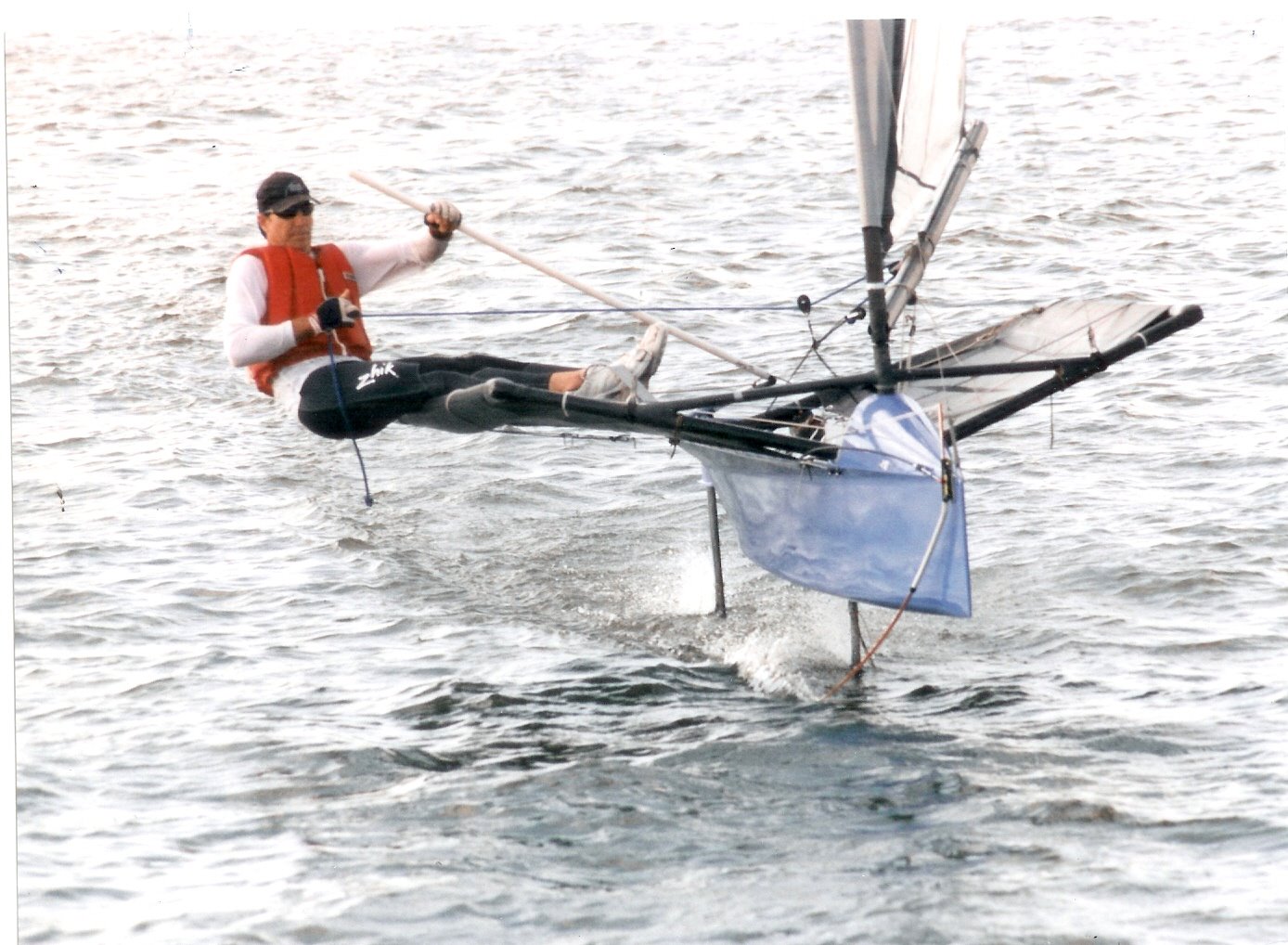
So how would someone handicap a foiler? Below is a pic taken by Ed Salva a couple of weeks ago at Elizabeth City after the racing of the classic moth nationals. John Zseleczky is foiling past Mike Parsons (who finished 2nd in the Nationals in his Mistral behind Jeff Linton in his Mousetrap design). The Mistral seems to be the typeform of the fastest hull: narrow waterline, full beam out to 60". The CMBA bars wings with a concavity rule.

So here's the question for the day: How should a well sorted foiler be rated? Obviously, different numbers for foiling and non-foiling conditions. The RYA pegs the moth at 98 (non-foiling) and 69 (foiling.) My guess is the non-foiling is about right but the foiling number should be lower, maybe around 60. Below are some numbers to consider, comparing USSailing and RYA numbers for identical classes. In most cases, the British data indicates that boats sailing in handicap starts are slower than their US counterparts. USSailing fails to list the International Moth at all, only the "classic" moth at a too high 107.1 (the reason I won the race.)
Class USSailing RYA
505 79.8 90.2
49er 68.2 74.4
Laser 91.1 108.0
IC 79.1 90.5
Mirror 113.1 138.5
A Cat 64.5 69.0
Moth ----- 98 (non-foiling)
Moth ----- 69 (foiling)
Anybody else want to take a shot?
Sunday, September 26, 2010
Classic Moth Nationals


Last weekend was the Classic Moth National Championship in Elizabeth City, NC, "The home of the mothboat." I was racing Aftermath, my wife's modified Shelley and finished 6th. Jeff Linton won the regatta, hosted by the Classic Moth Boat Association, besting Mike Parsons and Mark Saunders. Elizabeth City is an interesting venue. Fresh water with little to no current, a nice grassy lawn (the home of John and Sarah Pugh) to rig up on, and a floating dock that allows launching into four feet of water.
The town is small and dotes on the itinerate sailor: the municipal marina is a stopover on the intercoastal waterway and the local chamber of commerce has adopted the moniker "the Harbor of Hospitality," complete with a logo of a classic moth on the town's water tank.


More interesting was the after race activities on Saturday: both Mike Parsons and John Zscleczky brought down their homebuilt foilers. John's Hungry Beaver is pretty well sorted - the only obvious glitch was his fixed gantry was not angled enough to provide sufficient rudder lift. Even cranking the worm gear to its maximum extent the ride was still bow up. John says his plan is to remove and shim his rudder horizontal to help get more lift.


Mike's Stevo is still a work in progress. Sailing it reminded me of my boat two years ago: the hull, rack, and rig are sound but the foils and foil control systems still need lots of work. The obvious problem was high flights often resulting on sudden crashes. We tweaked the morse cable lengths and played with the wand settings but still couldn't get stable flight. The fact that the breeze was around 10 kts didn't help (perhaps in more wind things would have been better.)
John and I will be sailing in a couple of weeks at the HHPDO in Rye, NY. John in his Hungry Beaver; I will be in a borrowed Bladerider.
Sunday, September 12, 2010
$10,000,000

How can a young sailor on his or her own (not living with the 'rents) afford to sail in the upcoming world championships? I know even for me, a fifty something professional, trying to procure a $10 million liability policy would be a challenge. I'm pretty sure it's not something a twenty something sailor in the USA would be able to pick up. What magic in Australia allows such a policy to be written?
Movie Videos & Movie Scenes at MOVIECLIPS.com
Saturday, September 11, 2010
Opening the facebook
I've resisted the facebook/twitter/social media phenomena until now, but with Richard's prompt as a way to increase communication among the US mothies, I've joined. We'll have to see if it's useful or a waste of time. I don't expect to do a lot of "chatting" or otherwise friending and being friended, except for moth related activities.
Now, back to finishing up gantry #3. The Classic moth nationals are next week and I hope to bring Try-Foil as a play/demo toy before and after the racing. It was three years ago next week that I first tried Bill's boat and was smitten, as described here.
Now, back to finishing up gantry #3. The Classic moth nationals are next week and I hope to bring Try-Foil as a play/demo toy before and after the racing. It was three years ago next week that I first tried Bill's boat and was smitten, as described here.
Saturday, August 28, 2010
Back to Boatwork
I've got a few projects on the table before I can get sailing again. With the collapse of my mainfoil in Harbor Springs I need to resurrect my original mainfoil I built in the fall of '07 with Gui's guidance. The foil is a bit fat by today's standards but does work. It will be mated to a strut I built last spring from John Z's mold. The strut is pretty strong (maple core) but a bit shorter than the current trends. I've decided that the pair will not be separable - I'll glue and carbon the tee-joint to try to git it a bit more strength. I'll also have to layup a well section and build a new cassette to fit the boat. My top end adjustable feature is working fine so I should be able to tweak the AoA and find the best position after a few sails. There will undoubtably be some tweaks to the bell crank and pushrod. I'll be using a 2.5 mm FC pushrod that broke at the bottom end but will be long enough for my shorter strut. I'll have to dig out the tapped barrel in the flap and re-tap to the larger size (I had been using 1/8" pushrod.) The ultimate long term goal after saving lots of pennies will be to fit a new production strut and mainfoil from one of the professional builders.
I'm also finishing off a new gantry (my third.) My existing gantry is kludged together after failing in the Gorge. The "agricultural repair" (as Bear put it) has held up, but I'd like to loose the aluminum plate and the through bolts. The new gantry keeps the forward cant of the rudder but should be lighter and stronger. It is also cleaner, without the bottle screw and fairing of my existing gantry.
Lastly, I'm tweaking the rack's front end. To make the rack system able to be taken apart I had included a sleeve and throughbolt on one side. There has developed some wear and play which caused me to lose rig tension during the course of a sail. The beefed up rack should be able to take the rig and hiking loads without shifting.
My goal is to have everything done by mid September. There is a long distance race that weekend that I'd like to sail in and then the HHPDO in October. Of course, everything will have to be fit in around school since it's back in session now. Pics to follow in future posts.
Subscribe to:
Posts (Atom)