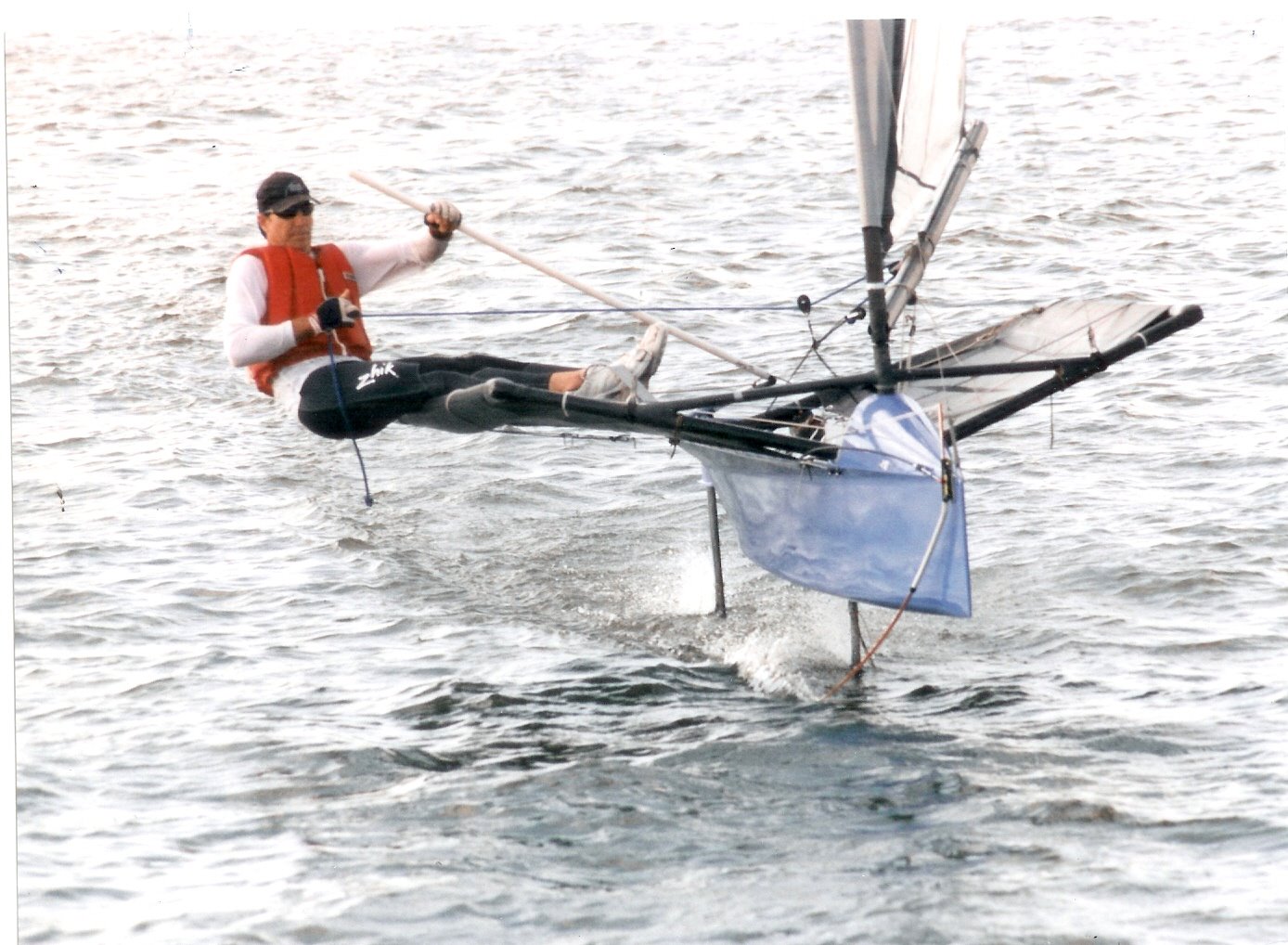
Yesterday was the annual Norfolk Yacht and Country Labor Day regatta, a fixture on the lower Bay sailing calendar since there's been dinghy racing on the Chesapeake. Moths have been racing in this regatta for over 7 decades. The class winner in the Hampton One-design class is awarded a perpetual trophy, the Governor's Cup, that also dates back at least 60 years. We Susan and I showed up with our classic moths, we found Walt and George (who had driven up from Greenville.) A small fleet of four, but we knew gas prices were high and some of the regulars had either relocated (Mark to South Carolina) or had other pressing items on their plate (Greg was gearing up to organize the Nationals in just two more weeks.) At any rate we had a great time. The breeze fluctuated around 7 knots, never dropping below 4 and building to around 11-12 by the last race. There was an ebb tide that added just the right amount of current to make calling laylines interesting. The committee got off seven races on a windward-leeward course situated just off the club. The larger boats had to sail out to the channel off ODU and managed fewer races and more current. On the inside course we had a blast. We even traded boats between races, with a junior instructor from the club in the mark set boat jumping into the fray for three races (he sailed Try-Umph, then Aftermath, then Walt's Europe.)
Walt had to bail out a bit early so only sailed 6 races and Susan sat out two races and the scoring was both by sail number and by helmsman so the results are somewhat muddled but we had a blast. I ended up with 6 bullets and a second. My boat did pretty well with 6 firsts and a 4th. George finished one race first in my boat (and I got second in Lumpy). Aftermath also took a first, with me at the helm. I suppose it usually is all about the driver, but that's pretty well accepted.
So was there anything unusual about the day? You betcha! On the last weekend of the summer, with beautiful weather of sunny skies, 90 degrees and a perfect breeze for anyone (even green fleet Opti kids,) there were only the Moths and the Hamptons racing (and only 6 Hampton O-Ds at that.) There were NO junior sailors. It was only a year or two back when this regatta had hordes of Optis from both Norfolk and Hampton. In years past we actually enjoyed sailing in and around the Optis as they made comments about how "cool" our moths were. The older juniors at the club race 420s and CJs. In fact, the club boasts about 30 Optis and 30 double handed trainers on a floating dock just ready to sail. Not a single one was launched yesterday. When I asked the junior instructor where the kids were on this perfect regatta day I got a couple of replies..."It's cooler to go stand-up paddleboarding down in Duck (on the Outer Banks)," and "They didn't know about the regatta," and "The good Opti kids only race the major regattas now-a-days and couldn't be bothered with this little race." I thought how sad. If the hot-shots are gone what a great opportunity this was for the kids that usually inhabit the back end of the fleet and for the green fleet's novices. But perhaps the back end of the fleet has given up sailing. Maybe the back 80% of the fleet has given up sailing. If only the top competitors compete and those top kids don't show, what happens? To paraphrase Bertolt Brecht, What if they gave a regatta and nobody came?
This lack of juniors racing and the decline in participation in small boat sailing in general may be common as we move deeper and deeper into the virtual world (Susan commented that the kids don't sail real boats anymore, because "there's an app for that..."). But surely if the base is not growing, and in reality is probably shrinking, how can that possibly be good for the top? Reference the gnashing and grinding of teeth after the USA failed to medal in Weymouth. Maybe it's the culture of if you don't perform at the top, it's not worth playing the game. I did like the Nike commercial about "Finding your greatness" aired during the London games. Let's only hope that "your greatness" will be understood to mean "not the world's greatness." If the bulk of the fleet gives up sailing it may be because the boat is boring. Not so with the moth! Witness the record turn-out at the last worlds. On a related note I saw that Anja continues to document the entire moth fleet. Her pictures of Campione are so much more inclusive of the fleet when compared to those of Thierry who concentrates on the pointy end. Yep, I'm still mothing and hope to be at Hayling Island in 2014. Hawaii is out just because of the calendar. Teaching school frees up the summer months but demands that I stay focused from mid-August to June.