Friday, March 14, 2025

The 40-Tryner saga

 My 4 year excursion into boat designing and building a craft for the Everglades Challenge.

My Everglades Challenge story.

I first started thinking about the Everglades Challenge in 2021. My interest was piqued by Jeff Linton. Jeff also sailed classic moth boats and had competed in the Everglades challenge for years with Jahn Tihansky in a modified Flying Scot and then in a custom  22’ OH Rodgers design. I was interested in class 4 (sailboat monohulls) but in the singlehanded division.  I thought a lightweight hull with higher performance would be the ticket. I discarded the moth boat idea immediately but thought about my time in an international canoe, a longer boat that might be more suitable. I acquired an old Ted Causey canoe from a guy in Charlottesville and visited the Clarks up in Rhode Island for some help with canoes. Steve passed along a usable seat and gave me plans to build a carriage. That summer I sailed in the IC North Americans in Rhode Island in a borrowed boat.

 My first thought was to widen the canoe to five feet for a rowing station and to that end I took a mold off of the Causey canoe, split the mold down the middle and added a flat wedge 0 inches wide at the bow and about 30 inches wide at the stern to achieve a five foot beam at the gunwale. I finished and faired the mold and that summer experimented with spraying gel coat and laying up carbon. I was using Nomex for a core and some Kevlar for reinforcement along the keel line. By myself I was not able to lay up the entire hull but got about 3 feet of the bow finished before it became obvious this was going to be too time consuming to finish it in time for the 2023 race.

At the 2022 Moth midwinters I picked up a used 49er from a chap in Miami. The boat was pretty complete and included an aluminum trolley. For $1000 I figured I got my money's worth, with if nothing else the hardware and the spars. My initial thought was to discard the wings and install sliding seat on the 49er hull. Some time rowing the hull without the rig and with the sliding seat carriage just sitting on board, convinced me that the rowing station and the canoe sliding carriage arrangement were not compatible. Jeff had counseled me not to discard the wings so Plan B was to use the 49er hull with the wings and a modified rig. For no-wind propulsion I thought rowing single handed would be problematic especially going up into the narrow waterways in and out of the checkpoints. I had competed in the 2022 North Carolina Challenge in a borrowed Tandem Island trimaran and was pleased with the whole setup except for the windward ability. So my thoughts turned to using the Mirage drive on the 49er hull and improving the windward ability of any boat I would sail (I was leading the NCC until the last 30 mile stretch to weather when Skinny Jeans in his Thistle beat me.) 


A test sail on 49er with a drastically cut down mainsail and jib in 15 knots of wind in Willoughby Bay convinced me that the traditional slab reefing approach was not suitable on such a lightweight hull, especially single handed. So my next thought was to use the TI's roller furling mainsail on the 49er hull. To support a jib and any off-wind sails I would need to have a stayed mast forward of the rotating mast. A well with a pedaling station forward of the stayed mast would accommodate the Mirage drive. Steering would be via lines similar to a rowing shell’s coxswain arrangement. So, with these choices made I started building. I had a nice Ted van Dusen carbon mast which was about the length of the Tandem Island mast. Hobie sold parts separately that I needed: an insert for the Mirage drive, the socket and supporting beam for the rotating mast. I also had an old 1960s vintage Needlespar aluminum moth mast that I would use to support the jib halyard and spinnaker halyard. A proof of concept was launched in the fall of 2022.


Over the next few months I built lots of bits and pieces. A big idea was to provide some leech tension with a rotating boom and a nine foot long traveler. The required sheeting angle was much further aft than the stern of the boat so I built some elevated tail fins to support the traveler.


The boom had its own socket and the sheeting angle was in line with the boom angle to reduce forces on the boom. A grainy picture taken from off Anna  Maria Island on my 2024 EC attempt shows the basic setup. Also note the old big boat jib that was recut to act as a mainsail.


In the 2024 race the forecast was no downwind work so I left the spinnaker ashore and didn’t even take the bowsprit. In practice sessions I had trouble retrieving the spinnaker 100% of the time and was seriously considering getting another sail built that could be flown from a furler.

In the 2024 race there were seven entries in the Class 4 singlehanded division and I beat all of them to the first and second checkpoints. I was the third Class 4 boat to arrive at the first checkpoint, about six hours behind Jeff and Jahn. Leaving Cape Haze I made a strategic mistake and went back out Stump inlet instead of going south to Gasparilla, losing hours in my trek to Checkpoint 2. The second night also revealed a flaw in the boat design that wasn’t apparent before. At night in light air to weather the boat was not easy to steer – it had excessive lee helm. After closing my eyes for just a bit I would open them and find myself on a broad reach. I went to shore to anchor and catch some sleep before continuing on to day three. My navigation into checkpoint two (Chocko) was trial and error. I had a hard time finding Indian Key and the channel into Chokoloskee Bay. By the time I reached the checkpoint I was ready to call it quits. Even so, I was still the first Class 4 single handed entry to arrive, and the eight overall monohull to Chocko. 2024 proved to be a rough year. None of the Class 4 singlehanded entries made it past Chocko.

I was in pretty sad shape when they took my picture!


The major problems on my 2024 attempt were: (1) not having routing programmed into the Maptattoo, (2) having a crack in the Mirage drive well causing water to enter into the foredeck area, and then aft into the main hull, and not having a way of removing the water once it got below deck, and (3) having a personal issue with shitting myself in the drysuit. The helm balance contributed to the poor windward work, even though I was faster than most of the monohulls. 

So how about 2025???

Major upgrades prior to the start included a new gennaker on a nifty Harken furler, an actual Hobie TI sail instead of the cut-down big boat jib, and a sump well that could accommodate a hand bilge pump that I could operate at the pedaling station.

Some photos on the beach prior to the top start and shortly after launching passing behind an incoming freighter.


Again, I made great time to checkpoint 1, arriving in 14 hours and 33 minutes, first in the singlehanded division and third overall in class 4, ahead of 20 other entries.  I made a pithy comment, then slurped some noodles and made a quick pitstop. I was feeling pretty good.


In this attempt I had the routing with about 20 waypoints programmed in to the Maptattoo to go south and exit Gasparilla. So even though it was pretty dark, I managed to get back out into the gulf without issue. With the sunrise the wind started to build and during this 112 mile leg I experienced something I hadn’t in quite some time. About 10 miles south of Sanibel Island I was broad reaching in about 12 knots of wind with all three sails drawing. The Garmin showed a 10 min average of about 10 knots, but there were certainly some bursts of speed closer to 14 knots. I was sitting all of the way back on the wing and just trying to keep things upright. In my younger days I probably would have been whooping it up, hoping for more wind, but with each gust I became more worried. To douse sails I need to go forward but with waves coming over the bow I need to stay aft. A line from Jethro Tull’s Locomotive Breath came to mind: “Old Charlie stole the handle, And the train it won't stop going, No way to slow down…” Worry morphed into anxiety into fear. I was alone, far offshore out of sight of everyone, with thoughts of losing control and capsizing. Earlier in the morning I did exchange reaches with a couple of guys in a Tornado Cat (what was I doing keeping pace with a Tornado off the wind?!?) Fortunately the wind eventually eased  back to about 10 knots and I reached to the shoreline, continuing the leg just off the beach. I figured if I got into trouble someone might see me and take action.


Another issue came to light when I approached Cape Romano. The chart showed shoals from the Cape to about three miles out, and with the fetch I thought it might be too risky to sail through the chop. There was a passage before the Cape, but I had not programmed it into the GPS. I had the e-chart and picked my way through the inlet and out into Sullivan Bay toward Indian Key, the entrance into Chokco. Unfortunately, the wind had again built and was directly astern. There was probably some water below deck and the boat was hard to steer in the puffs. A 10-minute average showed over 8 mph but I know I had some higher bursts during this stretch, enough for me to call it a day. I furled all of the sails and stopped for a while, just drifting and trying to collect my wits. Eventually I calmed down and proceeded to the entrance into Chokoloskee Bay. My timidness probably cost me 30 minutes or so, something that would prove detrimental as the sun set.


When I got in the mangroves and more sheltered waters, I took a moment to pump out some water. This necessitated me furling the sails and walking in front of the masts to the pedaling station. As I was pumping and pedaling I noted the tides starting to ebb out and the wind starting to drop. I quickly got back aft and started sailing hoping to get through the channel into the Bay. No luck. For the next four hours I slowed to a crawl, barely making headway against the current. I drifted out of the channel once and had to hop overboard and pull the boat back into deeper water. I was tired and frustrated. It took almost five hours to make it to the checkpoint (I arrived about 11:10 pm.) Even so, I was still the 4th boat in class 4 to arrive, at 1 day, 14 hours, and 40 minutes, ahead of all of the singlehanded competitors and ahead of 13 of the double-/triple-handed monohulls. I was only 13 hours behind Jeff and Jahn. By this point in the race three of the single-handed and two of the double-handed entries had dropped out.


Once at the checkpoint I faced the dreaded mud. I anchored and trudged 50 yards through knee-deep mud. Luckly there was a fish cleaning station and I got a chance to rinse the dry bags and dry suit off. I was exhausted and slept on the ground on my air mattress in the emergency sleeping bag, not even bothering to set up the tent.


I awoke cold and ready to get back in the race at about 0515. My Maptattoo routing with about 20 waypoints got me cleanly off through Rabbit Key passage and back into the Gulf. With the sunrise the wind again began to build but now from abeam to slight ahead of the beam.


I was still moving faster than I felt comfortable with. My ass was raw and I was sitting on my left hip on the air mattress when about 1030 in the morning a stronger than average gust hit and the boat almost capsized. The starboard beach roller prevented the boat from going over as I quickly released and then dosed the gennaker. I lost overboard the air mattress and one of the dry bags so I had to turn around and retrieve them. For the rest of the day I sailed conservatively averaging about 5 knots to Northwest Cape. The wind had gone east by now and it would be beating to weather for the rest of the race. Around sunset things began to fall apart.


As the third night fell, I found myself hardly making any way against the tide and knew I needed some sleep. The plan was to head to shore, anchor and wait out the tide. Here I made the first stupid mistake. The boat ran aground (as planned) and I lowered the anchor to the bottom. I’ve taught seamanship for decades and even so, I made a rookie mistake. I didn’t tie the rode off before lowering the anchor, thinking I could just lash it off as the rode tightened. Unfortunately there was a strong ebb (2kts?) and I couldn’t manage to secure the bitter end as the boat drifted strongly down current. It was either release it or get pulled overboard. I released it and now had no anchor. Shit! Plan B: sail the boat hard aground and hope it stayed put. With the board hard down I sailed until the boat was aground and quickly furled the sails and went to sleep, probably at 1900. Five and a half hours later I woke (0030) and found the boat had drifted a few miles down current. So, I started sailing again, trying to recover lost ground. It took me four hours to finally make the entrance channel into Flamingo. Some folks got my picture arriving.

These pics show the pedaling arrangement with the pump between my legs. I should have spent more time pumping and less pedaling but I was eager to get off the boat.


Once ashore (I arrived at 2 days, 22 hours, 11 minutes) I got out of the boat and got some coffee and made a head call. One of my objectives was to break Jarhead’s class 4 singlehanded record of 2 days 23 hours and 45 minutes. Obviously, that was beyond reach (but if I had gotten to Flamingo before the wind shifted, who knows?) As it was, even with the night’s fiasco I was the eight class 4 boat into the checkpoint and still the first single-hander.


  In hindsight I should have stopped, cleaned up at the showers, changed clothes and completely pumped out the boat, but I wasn’t thinking straight. After a short break I left about 0730 and followed a few boats toward the Murray-Clive passage. All day was to weather and since the breeze had been blowing steadily for a day there was some wave action. My “watertight” deck hatches weren’t, and as the day wore on the boat started to go slower and slower. By 2030 everything fell apart.


I should have just stopped and pumped the boat out. I thought if I could get close enough to the shore I would be out of the waves and could pedal and pump. But each wave over the bow exasperated the leaking. Eventually the boat just stopped responding to the rudder. I couldn’t even tack, having to gybe around to change tacks. Foolishly I opened one of the hatches and started bailing with a Clorox bottle bailer. Water was coming in as fast as I bailed it out. A slight gust rolled the boat over. I righted it, scrambled aboard and tried to furl the sails, The gennaker sheets had come uncleated and fouled the jib as I was furling it. The boat rolled again. I had to swim to the masthead and cut the gennaker halyard and gather the sail onto the foredeck. During one of the capsizes the pump bailer came loose from its mount and went overboard. In the swimming and reboarding I found my legs about 20 pounds heavier. The relief flap on the dry suit was not completely closed and the drysuit was flooded. I took off the drysuit (I had a nice fleece and insulated long johns so wasn’t cold.) But I was now in extremis. The boat was upright but completely swamped. I was kneeling in about 6 inches of water and realized I needed to “pull the ripcord.” I first tried to get the flares and radio from the drybags. I couldn’t find them and even though this wasn’t technically a “MAYDAY” situation (would anyone have responded if I could transmit a PAN-PAN-PAN message?) at 0200 I initiated an SOS using the PLB, the Garmin InReach, and the Spot. The phone was dead, failing to secure it in its own drybag. It was 1 hour and 15 minutes before the Coast Guard arrived. They picked me off the boat, left it adrift (no anchor, remember) and hustled me back to the Islamorada CG station (about a 40-minute ride.) On the way they called Susan and she was waiting when I arrived. We were back at Key Largo by 0400. I was completely knackered, but alive.

The boat stranded on a flat and was sighted by Mark Cockerham on Thursday and we successfully retrieved it on Friday morning.

A screengrab from a video taken by Mark. The video is posted on the Watertribe Facebook page. We waded out onto the flat and pumped out as much water as we could with a Rule 2000 pump attached to a 12 v battery. Once mostly empty we dragged it off the flat, I removed the Mirage drive and prepared for the tow. Once under tow on a plane I pulled the stern plug to get the boat almost completely empty.

 Lessons Learned.

(    (1) The 49er is a well-designed and balanced boat. The large aft raked mainsail is countered by a large daggerboard and rudder (and two men on trapezes). By using a smaller mainsail with no rake I threw off the balance and had a resulting lee helm. If my centerboard and rudder were raised a little in shallow water or if the main was partially furled, the phenomenon was exasperated. Probably not too much an issue when broad reaching, but was definitely felt when going to weather. Lesson: building a boat to specs is one thing; trying to build a boat/rig without consideration of forces involved is something else altogether. My next EC attempt will be in a well- designed boat (I’m thinking of a Core Sound 17 Mk3.)


 (2)   You can’t finish first if you don’t finish. Extreme fatigue mixed with some hubris got me on nights two and three. Instead of envisioning myself accepting the class 4 singlehanded division first place award, I should have thought through the basic seamanship principles: secure a rode before deploying an anchor; keep the bilges dry even if you have to stop sailing to do it; sleep if you have to.

(3  (3) Long distance single handed sailing is hard. Physical needs are paramount. Comfort while at the helm and the ability to get some sleep or to relieve oneself are not niceties but are necessities. Without these attributes extreme fatigue and poor decision making are guaranteed to follow. A good boat should be able to use a tiller tamer or an auto pilot for short stretches. A functional GPS routing system is needed. I was pleased with the Maptattoo. The only issue was leaving Flamingo with it only being 25% charged.

(4  (4)  Practice all communication methods in the dark. I had a hard time knowing how deploy the SOS measures I used when I couldn’t clearly see the devices.

(5  (5) Sportboats are not for old men with three replacement joints!


Thanks for reading.


Friday, October 26, 2018

Memories - written in 2007 - with the postscript in 2013


"Seduced Again"

Anyone who has sailed long enough has had that experience of  “Wow! This is what it’s all about.”  For some, including me, the experience includes an adrenaline rush brought on by speed and power. Big boats sailors get it, dinghy sailors get it, multi-hull sailors and sailboarders get it.  I’ve had that experience on all of those platforms. I recall the first time the speedo broke double digits during a breezy downhill spinnaker run on the J-33. Of course, included are the numerous times I was whooping with delight on the heavy air broad reaches on my Laser. Or on the canoe, blasting to weather, hiking off the end of the sliding seat. Surely, hitting twenty knots with the weather hull kissing the tops of the waves on a NACRA 5.2. And definitely sailing a short board with the hull seemingly in the air as much as it was in the water as I skipped across the surface of Willoughby Bay. But all of those experiences happened back in my younger days. It’s been almost twenty years since I’ve heard the siren’s song. Six weeks ago she grabbed my attention with a whispered “shussssssssssssh.”
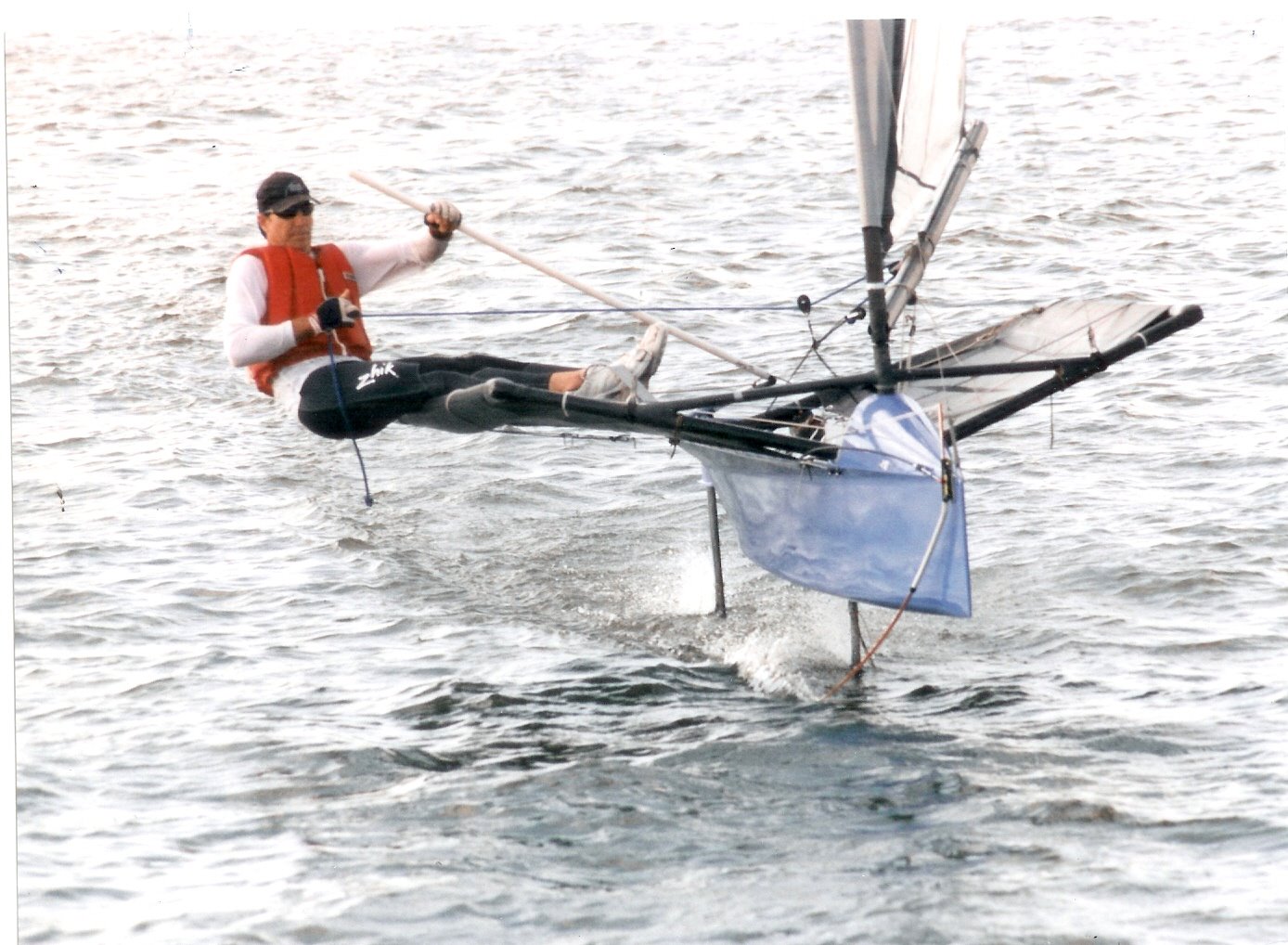
      The occasion was the classic moth nationals in Elizabeth City. After we finished racing on Saturday, Bill Beaver loaned me his foiler Bambi Gets High. Within five minutes, without having to tack once, I was foiling. Actually it would have happened sooner but the wind was in the 8-10 knot range and I needed the slight puff to lift my 175 pounds off the surface. I had read about the moment in numerous moth blogs but until I experienced it I didn’t really understand.  In every other boat I’ve sailed, the faster it went the more noise it made. The crashing through the waves, the splashing of spray and foam, the creaking of the rig, the hum of the board or rudder and the occasional flogging of the sail – these things are the hallmarks of power and speed. Until now. As the Hungry Beaver rose from the water and accelerated, the noise that meant a boat was going fast went away. Silence. Wonder. Amazement. A quiet shusssssssssh as the foils sliced through the Pasquotank River. I was immediately smitten. 
    Bill has gotten it right. His foiler was immaculately prepared and constructed so that even I, a 52 year old high school teacher, could scamper aboard and feel in control.  During one sustained puff I was hiking full out off the rack, steering and holding the sheet with one hand as I dangled my other hand down and dragged it through the water, all the while being foil-borne 24 inches above the river. Compared to Bill’s earlier Bambi Meets Thumper, an extremely narrow low-rider, his new boat is forgiving and stable. The large diameter wing longitudinals and the Styrofoam he stuffed in the outer bit of the tramp allowed me to stay hooked in whenever the wind died and threatened to capsize me to weather. At the next puff I just needed a couple of quick pumps on the sheet and I was out of the water and moving smartly. Easier than waterstarting! Bill had told me that the area of the hull around the daggerboard was reinforced so that if I needed to stand on the hull to right it after a capsize, that was where I was to step. I never used that technique. Actually, righting and climbing aboard was much easier than my 1970’s Magnum moth design. 
     I’m now committed to having a foiler of my own. With Bill’s and Gui’s assistance, I started on the road to foiling last weekend. I’m working on the blades now and I’ve gotten a quote for a new KA sail and Burvill mast. I hope to start the hull before the holidays. By next spring my seductress will have her way with me. 
 
Stay tuned.  

Post Script:

So, yeah, it's sort of an addiction, a seduction, an urge that needs a periodic fix. The fact that my boat will probably never win a Gran Prix level regatta is rather irrelevant. In fact, I get the most pleasure just blasting across Willoughby Bay, my local piece of water, and coming ashore tired but satisfied -- even more so if nothing broke or if the latest fix seemed to be an improvement. 

Sunday, December 6, 2015

Moth as flight school vid

A new vid just posted.

It makes me want to get back on the boat...

Wednesday, July 30, 2014

Your boat in a museum?

One of my first madmothist posts, written exactly six years ago today as I was waiting for Try-Foil to be returned from Weymouth, was about the history of the Moth class and included a reference to the Mariner's Museum, which is only 45 minute from my house. After a short blurb in Scuttlebutt about an AC72 J-board being given to the Museum, I sent an e-mail to the Lyles Forbes, the chief curator. My note and his response are copied below.

So, there's an opportunity for someone's boat to gain international respect and be saved for posterity. Are there any unused boats about?

I see from the latest issue of Scuttlebutt that the Museum will be
getting a AC foil to add to the small boat collection. I'm a local 
(Norfolk) moth sailor and am familiar with the Museum and the 
small boat gallery. You may be aware that moths are also foiling 
now (and have been for ~10 years.)  Maybe the acquisition of a
foiling moth would be a nice comparison to the Silver Spray that
you now have.

Joe Bousquet

Lyles Forbes lforbes@marinersmuseum.org

Jul 29 (1 day ago)
to me
Dear Joe,

Thanks for your e mails this morning!  We do indeed
have the J-foil from the AC72 as well as a T-foil 
rudder from an AC45 now in the collection. Hopefully
we will be able to get them on display very soon – we
are trying to design a mount to support the foils.

As to your mention regarding the Moth class, 
absolutely I have been aware of their foiling 
capabilities for several years! The evolution of the 
current design from that of Silver Spray is really 
amazing. Although I think we ultimately would like
to have a foiling Moth for the collection, at the 
moment we are really out of room to display any 
more boats. We recently were given a large dhow from
Kenya, that has overtaken the area that my volunteers
used to conserve our collection.

However, if you become aware of a foiling Moth that
someone is interested in donating, I will certainly 
present that to our collections committee for 
discussion; as well as with our exhibition designer to
see if there is some way of displaying the boat in the 
Center.

Thanks again for contacting us, and hopefully you will
soon be able to view the Oracle foils in the 
International Small Craft Center!

Best regards,

Lyles Forbes
CHIEF CURATOR


Sunday, July 27, 2014

The blog is dead

Congrats to Nathan on the win. I wish I was there. Lots of stories to be told, I'm sure (for example, what happened to Dylan???) but the medium had undergone a sea change.

As witnessed by the most recent blogroll on the International Moth home page, the blogging among mothists is just about dead. Hmmmm....no posts about the worlds....what's up with that?

On the other hand, the Facebook page for the worlds has had lots of action. I suppose Facebook is a social blog, but I'm afraid the concept of individual blogging has past its prime.

The twitterverse has adequately covered the event on its site but I think the best overview came for the Yachts and Yachting coverage, even if it did neglect most of the fleet (70 of the 140 entries were in the silver fleet and it was a while before any mention of the back half was made.....)

I thought the Beau Outteridge Production pieces were okay, but their sailor profiles left a lot to be desired when compared to the extended interviews from Motterfeiber back in 2009.

So where do I go from here? Next week Susan and I will attempt to get her flying in Aftermath down on the Chowan River in North Carolina. I hope to race the boat at this year's classic moth nationals in September.

Stay tuned for occasional reports.

Friday, July 4, 2014

We hold these truths to be self-evident...

Happy Independence Day. In CONGRESS, July 4th, 1776...


As of today, Americans still only account for 3/131 entries. I wish I were one of them. Good luck to Dylan, Zach and Brad.

Concerning the decision to put the kibosh on efficient solid wings: I'm pretty sure it was made in the interest of keeping the class members happy for the near term (and, yes, because we are a class with a "una-rig" to use an old term) but that a collateral effect was to move the moth off the bleeding edge of development. 

I'm looking forward to reading about the championships, now only 2 weeks off.

Monday, June 16, 2014

Formula 1 on the water...

I just finished a week in Manteo assisting with the A-Cat North Americans. My impression is that the class is as techie as the Moth and at the top level has as strong a talent pool as the Moth. At the Takapuna worlds in February the foiling development took long strides due to the efforts of some cup sailors. That regatta was won by class stalwart Glenn Ashby. The NA Champ Bruce Mahoney finished 16th.


The A-Cat class claims the moniker "Formula One on the water," which was also used by the moth in years past. But the A-Class rule limits racing to a max wind of 22 knots. This past week saw a windiest day of 18 knots and there was lots of difficulty in boat handling from mid-fleet on down. In race 4 almost 50% of the fleet recorded a lettered score. Certainly in top regattas the moth is capable of much windier conditions. Even I can manage reasonably competently in up to 25 knots. So I suppose the moth talent pool is, if not deeper, certainly wider than that of the A-Cat.

Bruce Mahoney had brought back some of the latest gear from NZ and had moments of foiling, but by and large I didn't see a huge difference between the boats capable of sustained flight and those with the older C-boards. There was no doubt in my mind that the moth would have certainly been faster in any breeze from 10 knots on up. One of the most impressive aspects of the regatta was the well done media package. Each day there was a professionally done video by Richard and Rachel from Ocean Images. It was fun to see the action from afloat, from the drone and even from a helicopter. Mr. Clean's SA video reporting seemed primitive in comparison.

Preliminary video

Practice race

Day 1

Day 2 (no racing, but an explanation of foiling)

Day 3 (with some helicopter video)

Day 4


Sunday, June 8, 2014

Only three entries?

Looking at the most recent entry list for the '14 Moth Worlds at HISC I see just 3 of the 125 entries from the US. Deja vu from '77 when we only had 3/86 entries....

Friday, June 6, 2014

I'm all a-twitter

Back in the twittersphere @madmothist


Looking forward to reports from HISC since I probably won't be able to make it this time around... unless I hit the lottery. Someone suggested starting a crowdsourcing fund drive...somehow I don't think so.

Saturday, May 17, 2014

The Bar is Raised

Ned Goss recently posted a 36.6 knot top speed in Charleston. If a relative newcomwer to the class with a stock Mach2 can hit that speed, I would think that 40 knots should be achievable by an experienced mothist in a special purpose class legal moth.

From Velocitek

http://www.foilingweek.com/2014/05/35-9-knots-new-moth-speed-world-record-ned-goss-in-charleston-bay-usa/


Saturday, February 8, 2014

2014 Moth Worlds at Hayling Island

Well, as I look at the upcoming worlds at HISC I have to reluctantly admit I won't be able to make it this time around. I was hoping that circumstances and finances would align and I'd be able to make a return engagement. I did compete in the moth world championship at Hayling Island in 1977 as one of three Americans to make the trip. Our boats were fiberglass magnum 2s taken out of a mold from John Claridge's boat that he had sold to Ted Causey after the previous world champs in the States. Back in 1977 I had just graduated from college and had treated myself to a six week cycling vacation in England culminating with the regatta. As I fondly remember the experience I do have a bit of regret that I can't re-experience racing in Chichester Harbour and the Solent.

The 1970's were a simpler time in moth racing. I have to believe that our homemade boats were as competitive as the rest of the boats in the regatta and that the order of finish was determined more by sailing ability and less by the equipment. Of course the boats and rigs mattered, but as long as your hull was fairly light and stayed watertight and your rig had a decent sail you could have had a shot at the top end of the fleet.

As I look at the moths of today I realize that it's much more difficult for one person to build a competitive boat. I just watched a video about the "arms race" leading to the upcoming A-Cat worlds and I see things similar to the pointy end of the moth fleet: a very techie boat shop with some very talented builders and sailors working as a group to push the envelope.  There are folks who are very competitive with home built boats (Dave Lister, for example), but for me to have a chance, even in the silver fleet at a moth worlds, I'd probably have to sail something other than my six year old Hungry Beaver. As a minimum I would think that a new M2 or Exocet with a new rig would be required. Obviously the winners are those with the best skill set for the conditions but I would argue that the differences in the equipment used by the top ten finishers is slight. My boat wouldn't cut it this time around.

I'll keep playing the lottery once a week and maybe I'll hit a winner. Let's see...perhaps $30,000 for the package (and airfare, etc.) should do it..

Good luck all!

Sunday, October 27, 2013

Boat Names

Maybe I'm being a bit nostalgic, but when I was reviewing the list of entries at the 1977 Moth Worlds hosted by Hayling Island Sailing Club, I saw that of the 86 entries, all but 19 had submitted a boat name. Many were indicative of the home-built nature of the class back then, but some were just plain interesting. Why are boat names on today's moths seemingly rare?

At any rate, enjoy the following look back on mothing in the late 70s...and I wonder how many of these folks have made the transition to foiling other than me.

And, yes, I'd love to make the trip again next summer if I can get the funds....

                                    HAYING ISLAND SAILING CLUB
                                    INTERNATIONAL MOTH WORLD CHAMPIONSHIPS 1977
                                    LIST OF ENTRIES

Country                                    Helm                           Boat Name                              No.

AUSTRALIA                          C. Burton                     Red Ned                                  KA8467
________________________________________________________
CZECHOSLAVAKIA             P. Tomasch                  Troll II                                    CZ1
                                                R. Andil Jnr.                Troll                                       CZ11
_______________________________________________________
DENMARK                            J. Kold                                                                         D6
                                                H. Jensen                                                                    D22
                                                C. Mueller                                                                   D23
                                                T. Neilson                                                                    D24
                                                M. Freek                                                                      D25
                                                J. Boetter-Jensen                                                        D30
_______________________________________________________
FDR                                        J. Segger                      Guppy                                      G1
                                                A. Messtorff                Jaimte                                      G2
                                                S. Kickhofen                Winnie                                    G610
                                                W. Briegleb                 O-g                                          G672
                                                M. Zeller                     Jumbo                                      G714
                                                B. Buhler                     Behemoth                                G715
                                                U. Fischer                    Fischli                                      G724
                                                Erica Von Borcke                                                        G734
                                                J. Pichler                     Unke                                        G738
                                                S. Gunter                                                                     G753
                                                N. Rubach                                                                   G801
_______________________________________________________
HOLLAND                              D. de Boer                                                                    H3
                                                C. de Graaff                                                                  H7
                                                H. Hamberg                                                                  H10
______________________________________________

SOUTH AFRICA                   A. Lanham-Love          Merveille du Jour                    3600
________________________________________________________
SWEDEN                                M. Lindgren                 Goofy                                      S371
                                                U. Bowallius               Mitzigainoff                              S377
                                                R. Weigard                  Blabar                                      S381
                                                D. Bolenius                 Valkyrian II                              S407
                                                A. Galmark                                                                  S415
________________________________________________________
SWITZERLAND                     B. Guhl                        Guinea Pig                               Z415
                                                G. Werner                   Heya                                         Z420
                                                H. Jorg                        Hu                                             Z425
                                                A. Wickart                   Scho    Rot                               Z475
                                                C. Kuchli                     C.C.                                          Z478
                                                B. Wicki                      Half Night Wonder                  Z481
                                                T. Schiess                    Viola da Gamba                       Z482
                                                C. Guanziroli               Calimero                                  Z494
                                                H. Dreher                    L.S.D. 7                                    Z495
________________________________________________________
UNITED KINGDOM             C. Edwards
                                                B. Spencer                   Salty Dog                                K3346
                                                Yvonne Woodwell      Soapha                                    K3361
                                                R.D. Townsley                                                            K3435
                                                J.R. Woods                  Orange Underwing                 K3437
                                                A.R. Gould                  Limbo                                      K3468
                                                D.B. Hall                     Regular Dart                            K3498
                                                R. Elliston                   Slip and Grip                           K3501
                                                J. Iszatt                        Sprite Alite                              K3505
                                                R.J. Heseltine              Whiter Shade of Pale              K3520
                                                D. Surridge                  Lemming                                  K3525
                                                M.J. Wood                  Magnalium                               K3533
                                                N.G. Blake                  Norfolk Poacher                      K3541
                                                J. Pearce                      Sidewinder Too                       K3555
                                                B.C. Cox                     Sunny                                       K3560
                                                C. Reeves                    Wendigo                                  K3562
                                                C. Walker                    Vergin’ on the Wakehurst       K3566
                                                M. Iszatt                      Tumbleweed                            K3567
                                                P. Conway                   Great Uncle Bulgaria              K3574
                                                M. Brill                       Magnum-Opus                         K3602
                                                P. Iszatt                        Final Fling                               K3608
                                                M. Green                     Down Under                            K3615
                                                C. Cottrill                    Lucy Lastick                            K3617
                                                J. Spencer-Smith         X Tension                                K3619
                                                C.A. Evans                  9 Day Wonder                         K3622
                                                B. Short                       The Galloping Maggot of         K3632
                                                                                    Bexhill on Sea
                                                B. Cole                        Just William                             K3636
                                                D. Iszatt                       Super Womble                         K3643
                                                J.G. Claridge               Magnum III                              K3646
                                                P. Dives                      Charlie                                      K3647
                                                A.J. Francis                 Hunca Munca                          K3649
                                                R. Hargreaves             Try Again                                 K3660
                                                J. Byrne                       Sul                                           K3665
                                                M. Shepherd                Hawkwind                               K3666
                                                D. Barnes                    Warrior                                    K3667
                                                A. Prower                   Collusion                                  K3670
                                                J.H. Butler                   Truffles                                   K3671
                                                R. Oates                      The Waki-Racer                      K3673
                                                G. Pither                                                                      K3674
                                                T. Gale                        Intangible Sophistication         K3676
                                                J.C. Bull                                                                       K3677
                                                C. Eyre                        Cunning Stunt                          K3679
                                                B.M. Reeve                 K.K.T.F.S.B.U.                        K3680
                                                J. Meachen                                                                   K3681
                                                S. Allen                       Schizofrantic                            K3686
________________________________________________________
U.S.A.                                    J.A. Bousquet              Try-umph                                 US4191
                                                T. Lutton                                                                      US4197
                                                R. Wallio                                                                      US4198