Thursday, August 7, 2008

Get Smart! CONTROL vs. KAOS


Would you believe?

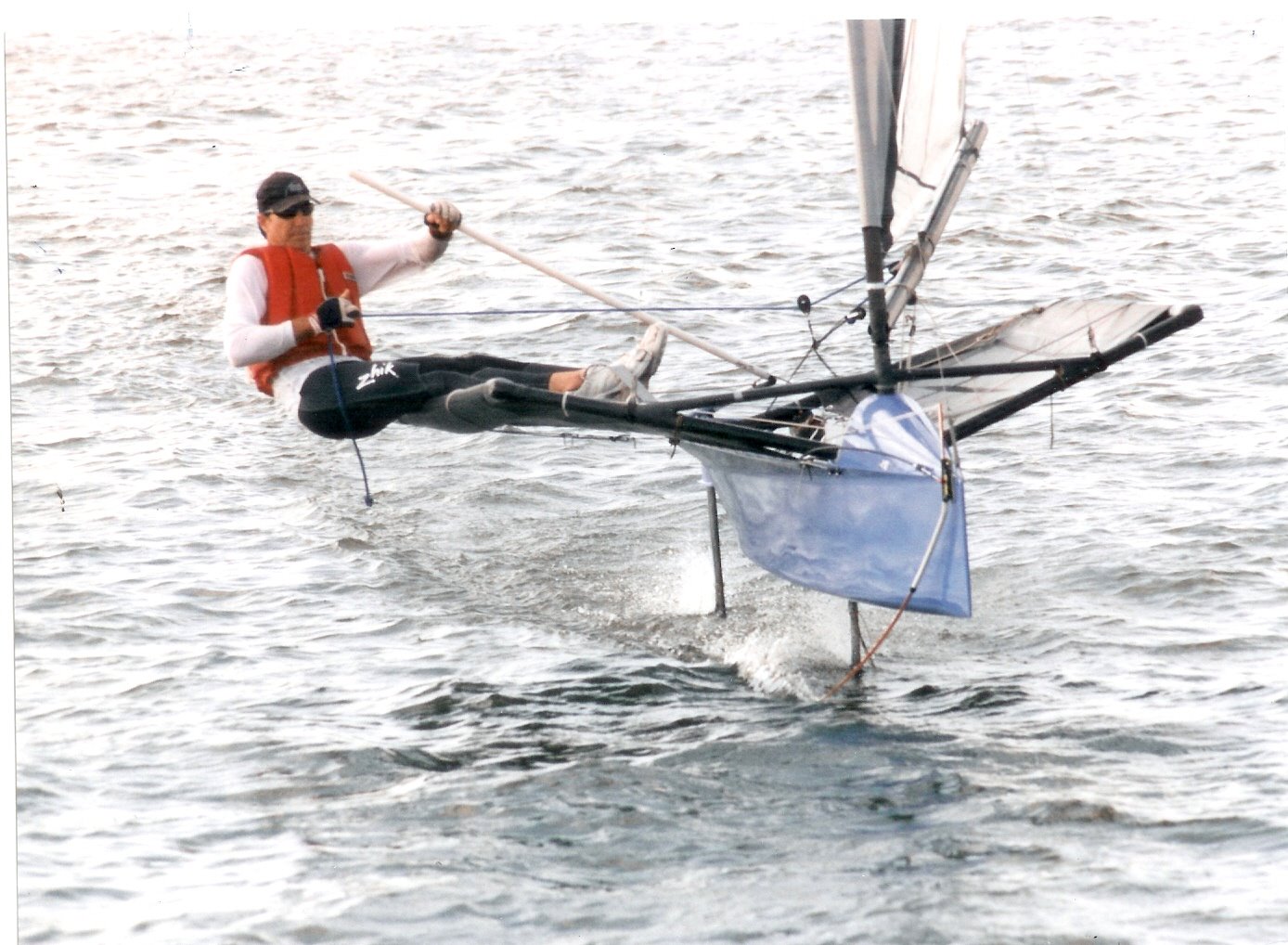
I think this television show (and now, movie) is a metaphor for my moth escapades. During today's sail the main foil rod pulled out of the tapped barrel in the flap, so I had no ability to generate negative flap angle. Normally a recipe for disastrous stacks, but fortunately the wind was only 10-14 knots. I managed to sail about 2 miles on a broad reach controlling ride height by my fore and aft weight placement. Surprisingly, everything went fine. I suppose that the AoA of the main foil with zero flap angle is just about right for these conditions. Of course, with more wind and more speed the ability to generate a negative flap angle is required. So back to the shop to re-engineer the mechanism.

My push rod is a 1/16" diameter stainless steel rod I bought from McMaster Carr. I used a tap and die set to cut threads in the rod and in a piece of brass that I embedded in the bottom of the flap. I do have another piece of 1/16" ss rod so I may just replace the rod with a newly treaded one. However, something tells me that it's the brass threading that has stripped out and that will require opening up the carbon on the bottom of the flap to remove the old brass and insert a newly tapped piece.

I understand that BR uses a 2.4 mm rod, and I may bump up my rod to the 0.094" diameter (the English equivalent) but then I need to buy a new tap and die for that size rod....

It's hard reigning in chaos!

Wednesday, August 6, 2008

Karl's Comment

In Moth Chronicles today Karl writes "It appears increasingly that the only people with enough time to do development work of any real value and sail at a high level are people who neither build nor blog. It doesn't hurt to be independently wealthy either..."

So I got to thinking about how wealthy is wealthy. Forgetting the development aspect for a minute and just looking at the price to buy a world-class production boat, I dragged out a 1975 price list from John Claridge, builder of arguably the top-of-the-line custom skiffs of that time. His 'Stage 5' Magnum 2, described in a glossy brochure as
A Complete Boat ready to win -- For the person who is financially able to take full advantage of John's experience this stage is an excellent value. All boats are fitted out with tried and tested gear, including alloy spars, self-bailer, ratchet main-sheet block, Saunders fully battened mainsail, etc., the excellent quality of finish, for which Claridge Boats are well known, colour to choice.
Cost was listed as 570GBP. Add the 12.5% V.A.T. and the total is 641.25GBP "ex works, Lymington." I then went to an on-line inflation calculator for dollars and pounds which shows that 641.25GBP in 1975 is approximately equivalent to $6000 in 2007, or about one third of the cost of a new Bladerider.

So, yeah, I know that this ain't 1975 and the carbon foilers of today are not the ply boats of yesteryear, but this difference still points out we are attracting a sailor with a significantly different income level. When boats are cheap, developemnt is easy. Now not only is the bar raised and the cost of Karl's "development work of real value" beyond most of us, the price even to play with the "standard" boat is three times what it was back in the day. Is it any wonder that the average Joe home builder (without the CNC and software) is in a definite minority?

I'm not going to fret. The boat's together and I'm going sailing. And, hey, as for the wealthy dudes and dudettes, at least by moving the empty crate into the garage, I can simulate the BR factory team repair stand....

Tuesday, August 5, 2008

The Loose Nut at the end of the Tiller


One of the challenges in building your own boat is to create systems that work (usually copying those on production boats) using materials at hand. The picture above shows my inner tiller mechanism I have to control the AoA of the rudder foil. The piece on the left shows the forward end of the inner tiller; the entire piece is about 28 inches long. On the aft end (out of the photo) is a slot for the rudder pin, a slot that also extends through the outer tiller. The pin attaches top and bottom to the fixed gantry. As the inner tiller moves fore and aft, the rudder cassette moves and alters the AoA of the foil. To force the inner tiller fore and aft is the worm gear show in the photo. It consists of a captive nut, a 1/4"-20 ss machine screw which is fixed in a "spool", that in turn is turned by twisting the hiking stick. The spool is held captive in the tiller by two sleeves, fixed by set screws through the outer tiller. Since the spool can't move fore and aft, any rotation of the machine screw will pull or push the inner tiller. And everything was working for a while....


Sometime either Thursday or Friday at Weymouth, the "captive" nut broke loose from the inner tiller, resulting in no fore and aft control of the rudder foil. Needless to say, the boat was unmanagable in the 20+ knots of breeze we had. I went out Friday for the last day of racing, but couldn't get the boat downwind -- it kept jumping out with violent stacks. My guess is that the water pressure was pushing the rudder aft and hence generating a negative angle of attack on the rudder foil which pulled the stern down and created a positive AoA on the main foil that the flap could not counter. At any rate, I had to come back in and counted four DNC's for Friday's races.

So the first order of business is to reset the nut so that it can't come loose. I've notched the points of the hex nut with a hacksaw to allow the thickened epoxy to key onto the nut. I've also put a flat piece of carbon (with a hole for the bolt) over the nut. Hopefully, these will keep the nut where it belongs. Of course I've learned that it's always the weak link that breaks, so if this problem is fixed, then there maybe a failure somewhere else....such is the life of the home builder: learn to sail the beast and also how to keep it together. I guess the bright side is that I don't have to rely on the factory repair team to fix every little glitch.

Monday, August 4, 2008

Deliverance!

Two photos say it all. Enough of internet mothing, I've got boats to build...or at least assemble.


Artist: Buffett Jimmy
Song: Boats To Build
Album: License to Chill
(with Alan Jackson)

It's time for a change
I'm tired of that same ol same
The same ol words the same ol lines
The same ol tricks and the same ol rhymes

Days precious days
Roll in and out like waves
I got boards to bend I got planks to nail
I got charts to make I got seas to sail

I'm gonna build me a boat
With these two hands
It'll be a fair curve
From a noble plan
Let the chips fall where they will
Cause I've got boats to build

Sails are just like wings
The wind can make em sing
Songs of life songs of hope
Songs to keep your dreams afloat
I'm gonna build me a boat
With these two hands
It'll be a fair curve
From a noble plan
Let the chips fall where they will
Cause I've got boats to build

Shores distant shores
There's where I'm headed for
Got the stars to guide my way
Sail into the light of day

I'm gonna build me a boat
With these two hands
It'll be a fair curve
From a noble plan
Let the chips fall where they will
Cause I've got boats to build

Sunday, August 3, 2008

Aftermath and 29ers in the Gorge


Today I sailed my wife's classic moth, Aftermath, up at Ware River. I couldn't justify paying the $40 entry fee for racing in a Portsmouth Handicap start so just knocked around for an hour or so. Sailing in a lowrider after foiling is like going back to the time before you got the addiction. It was a time of ignorance and innocence, but after the experience of foiling, anything else is wanting.

I also chatted with Kerry Stokes, an Opti mom who was sitting onshore watching the sailing on the junior course. Her husband is Gordie Stokes, a guy who was racing international moths back in the day (he, too, had competed at the Ware River worlds in 1976,) and is now sailing a 29er with one their sons, Kav. Gordie and Kav are doing the summer sailing excursion bit: last week they were at the 29er Nationals at the Gorge and this week they are up at another regatta in Buzzards Bay. Of course I wanted to know about their Gorge experience, and Kerry reports that it was "honking." Now, what's 'honking' to a sailor from the Chesapeake might just be a typical afternoon breeze to someone from SF Bay, so I'd take the comment with a grain of salt. There's nothing like real numbers to put the strength of breeze where it belongs. Too bad there's not a Windsonic anemometer at Cascade Locks like there was at Portland Harbor. Maybe by next year there will be. Kerry also commented about her husband's wonderful camping experience at the Gorge, punctuated at regular intervals by the passing trains. Whether or not train rumblings at the Gorge will compare with the cow mooings, seagull cawings, and general wind-shaking, tent-rattling we experienced this year at Pebble Bank is yet to be determined.


But back to Aftermath. There's an interesting story behind this boat. I got her as part of a deal from George Albaugh back around 2001. I had been racing my classic Mistral for a few years and had built a widened Sprite for Merv Wescoat to the classic restrictions (five foot beam with no wings) the winter of 1997/98. Both boats utilized a roll tank system that is documented here: The Bousquet Roll Tank system on a Skol moth. George wanted me to build a similar deck layout on a glass Shelley that he had and for payment he passed along a second Shelley he had found in a New Jersey garage. I then tore off the old deck (it was pretty rotten), raised the sheer forward and re-decked it with a high foredeck and my roll tanks aft.


The black-white demarcation shows the aftermath of the modification: everything white was built by Wm. McCutcheon on the Isle of Wight in the UK in the 1960's and everything black was my addition some thirty odd years later. So why the increase in sheer? The rebuild was for Susan, my wife. She requested a comfortable boat with plenty of head clearance. At the time, the classic moth had a restriction on boom height: no more than 12 inches above the deck. So, to increase the head clearance I simply raised the deck. The increase in sheer was to make the boat drier. The original design by John Shelley (a variation on his I-14 of the same era) had a claim to fame in that it was one of the first designs that could plane to weather in the right hands. The boat had a low deck and I imagine a good bit of spray would come aboard (as evidenced by the two thru-hull bailers in the cockpit floor.) My modifications of increased sheer, highly cambered fordeck and small footwell-type of cockpit allow the boat to stay dry in almost any wind condition. At any rate, Susan never needs a bailer as she enjoys "sailing around the buoys" in the classic fleet.

Saturday, August 2, 2008

Sailing Away from the Safe Harbor


"Twenty years from now you will be more disappointed by the things you didn't do than by the ones you did do. So throw off the bowlines. Sail away from the safe harbor. Catch the trade winds in your sails. Explore. Dream. Discover"
-- MARK TWAIN

So am I bummed about the benefit vs. cost of my trip to England? Well, a little, and I suppose I'm disappointed a bit, but I also know that if I didn't go I would have regretted it down the way. Yeah, staying home would have been safe, but as Michael Lillie writes in one of his songs: "Ships are safe in harbor, but that's not what ships are for..."

For those who don't know, I had a bout with Hodgkin's Disease about 25 years ago. So having been a bit closer to death than most, I tend to look at life differently than I might otherwise. I try to experience lots of things and push beyond the bounds of what I'm comfortable with. An example would be the trip Susan and I made in 2004 when we rode a tandem bike across the country.

Here's another quote that tends to motivate me:

"...but when I said that nothing had been done I erred in one important matter. We had definitely committed ourselves and were halfway out of our ruts. We had put down our passage money — booked a sailing to Bombay. This may sound too simple, but is great in consequence. Until one is committed, there is hesitancy, the chance to draw back, always ineffectiveness. Concerning all acts of initiative (and creation), there is one elementary truth the ignorance of which kills countless ideas and splendid plans: that the moment one definitely commits oneself, then providence moves too. A whole stream of events issues from the decision, raising in one's favor all manner of unforeseen incidents, meetings and material assistance, which no man could have dreamt would have come his way. I learned a deep respect for one of Goethe's couplets:
Whatever you can do, or dream you can do, begin it.
Boldness has genius, power, and magic in it!”
-- WILLIAM HUTCHINSON MURRAY, OBE from near the end of The Scottish Himalayan Expedition (1951).

So, yeah, if you're thinking about coming to the Worlds in the Gorge next year, I say go for it! I plan on being there, God willing, and hope to see you. If you don't make it because it's out of your comfort zone, you may regret your decision later.

Friday, August 1, 2008

Delivery scheduled, but what a cost!

Julie from the local SEKO office just called and told me the boat has cleared Customs and she scheduled the delivery of my "water sports equipment" for mid-day on Monday. So I lose another weekend of sailing, this time tomorrow's Ware River annual regatta. I really wanted to make this event because it's one of the few in the lower bay that has a handicapped start and I wanted to show off the foiler. Also, Ware River was the venue for the last Moth Worlds to be held in the States (back in 1976.)

So back to waiting for the boat. I did get the cost of the shipping the boat over to the UK from the freight forwarder: $1606.63. Still to come is the the bill to bring it back home. So my adventures in Weymouth will probably come in over $3K. It sure makes Nige's carry-on "windsurfer" approach with Virgin Atlantic seem the way to go.